
The level of misinformation about data center water use has reached biblical proportions. Claims that AI data centers are draining aquifers on a catastrophic scale routinely ignore cooling technology differences, national water-use comparisons, and the rapid shift toward closed-loop systems. The reality is more nuanced and far less apocalyptic than the loudest critics suggest.
Cooling is not one-size-fits-all
Some data centers, including certain Google facilities and other hyperscale operators, do use water. Traditional evaporative cooling, meaning cooling towers, rejects heat by evaporating water. This approach can be energy-efficient in many climates but consumes significant volumes, because the water leaves the system as vapor and must be replaced. That makeup water comes with additional periodic blowdown and flushing to control mineral buildup.
Most facilities, however, rely primarily on air cooling: traditional air conditioning, free cooling with outside air, or air-cooled chillers. These systems use essentially zero water for cooling. Air cooling remains widespread, especially in older or moderate-density facilities. Uptime Institute surveys continue to show air-based methods, including perimeter air cooling, close-coupled, and fresh air, as dominant across the broader industry even as liquid approaches grow.
High-density AI workloads change the equation. Modern GPU racks, often 100 kW and above, generate far more heat than traditional servers, and air struggles to remove it efficiently. That has driven adoption of liquid cooling, primarily direct-to-chip with immersion in some cases, for thermal performance.
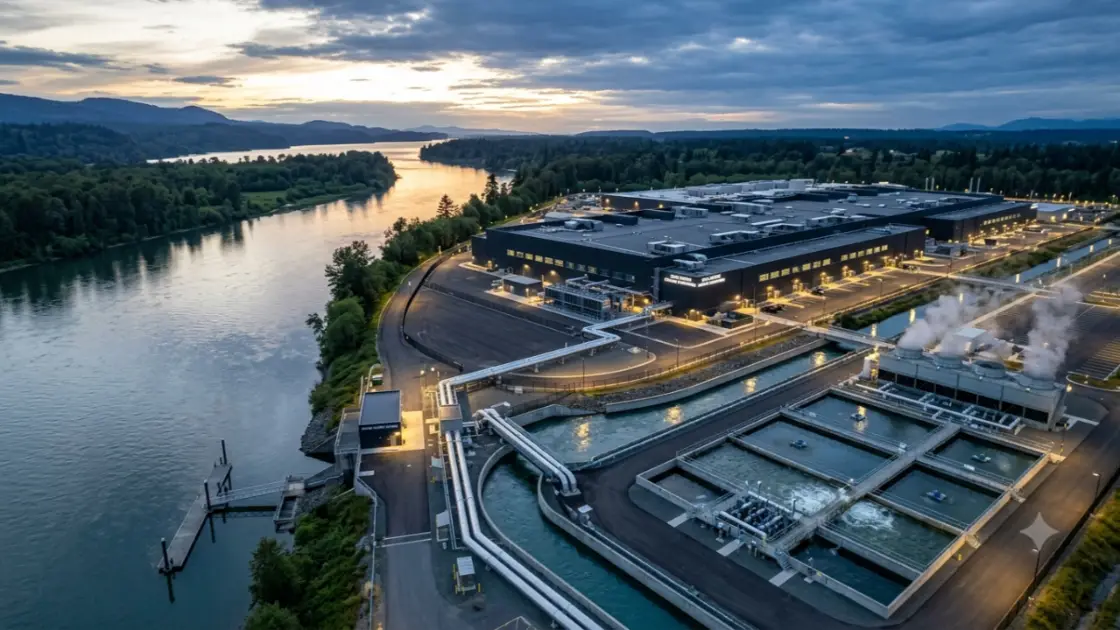
Critically, many of the newest designs intended for AI are closed-loop. Coolant, often a water-glycol mix, circulates continuously through cold plates or immersion baths and heat exchangers. Heat is rejected to air or dry coolers with little or no evaporation. After the initial fill, ongoing water consumption for cooling approaches zero, with top-ups limited to leaks, maintenance, or rare flushing.
Microsoft has publicly described next-generation AI-optimized designs that consume zero water for cooling during operations once filled. Nvidia reference designs and operators such as Oracle emphasize the same closed-loop principle. The industry is not uniformly thirsty. Technology choice and climate matter enormously.
The scale comparison that rarely appears in headlines
National numbers put the rhetoric in perspective. Lawrence Berkeley National Laboratory estimated U.S. data centers used roughly 17.4 billion gallons of water directly for cooling in 2023. Projections for 2028 range from about 38 to 73 billion gallons under growth scenarios.
U.S. golf courses, by contrast, applied about 1.63 million acre-feet of irrigation water in 2024, roughly 531 billion gallons, according to the Golf Course Superintendents Association of America and USGA survey. That is roughly 30 times the direct cooling water use of every data center in the country combined. Golf use has declined about 31% since 2005 through efficiency gains, while data center water use is rising with AI capacity. Even so, the gap remains large in the near term.
Google itself has noted that its global data center water consumption equates to a few dozen southwestern U.S. golf courses. An average 18-hole course can use hundreds of thousands of gallons per day depending on climate and region. A closed-loop hyperscale facility's ongoing cooling demand is a fraction of that after commissioning. The claim that an average golf course uses more water in a day than the entire water capacity of many modern hyperscalers is directionally consistent with closed-loop realities, even if "capacity" is sometimes used loosely for initial fill volumes, which can reach hundreds of thousands of gallons for large systems but are one-time.
Indirect water use embedded in electricity generation is larger still, but that footprint attaches to the power sector and the grid mix, not uniquely to data centers. Agriculture, residential outdoor irrigation, and other uses dwarf both golf and data centers.
Maintenance is real, exaggeration is the problem
Closed-loop systems are not magic. Water is topped up for evaporation of residual losses, leaks, or periodic maintenance and water-quality management. Blowdown occurs in open evaporative systems. These are ordinary industrial realities, not evidence of runaway consumption. Treating every gallon the same as continuous evaporative loss is the core of the misinformation.
Progress versus obstruction
Legitimate local concerns exist, especially in water-stressed basins where a large evaporative facility competes with other users. Siting, use of reclaimed water, and transparent reporting matter. Google, Microsoft, and others have published water data, replenishment projects, and technology roadmaps precisely because the scrutiny is real.
What does not help is the pattern of treating all data centers as identical water hogs while ignoring far larger, long-standing users and the rapid engineering shift toward low- and zero-consumptive cooling for the densest AI loads. Blanket opposition and inflated claims slow permitting, raise costs, and can push capacity into less optimal locations, or delay the very efficiency gains that reduce resource intensity per unit of compute.
Water is a real constraint in some places. Treating every new AI data center as an existential threat to aquifers, while golf courses, lawns, and certain crops continue with far less scrutiny, is not environmental stewardship. It is selective panic. Accurate numbers, technology distinctions, and proportional risk assessment are the only serious way forward.